It’s time for me to head back to Colorado and to work. Alan will stay in Big Bend until the end of April, and he’s already thinking about detours on his way back. So…another post before I go.
The last six weeks have been incredibly busy. No 8-hour days if you are a campground host, especially in the middle of spring break. Everyone warned us to expect record numbers of visitors. Gas prices are low, Texas Monthly featured the park in a 36-page spread, and 2016 is the National Park centennial. Spring break started before the end of February, reached its peak last weekend and might ease up after Easter weekend.
Our day begins with a quick breakfast followed by a tour of the 100 individual sites plus 4 group sites. Theoretically we could have 920 people; actually it’s about 500-600 on a busy day, perhaps as low as 300 on a slow day. Transportation choices include walking, riding tricycles or driving a pickup Alan affectionately calls ‘the garbage scow’. We check in those who arrived in the wee hours of the night and determine how many sites will be available for newcomers. Since anyone in a first come, first served campsite has until noon to either extend their stay or vacate their site, the number varies minute by minute.

Once we get the newcomers settled in, it’s time for paperwork (me) or cleaning campsites (Alan). The government wants to know how many people stayed here last night and if they slept in a tent or an RV. That means that if they slept in their car, we mark it as an RV. We’ve had campers tell us in the morning about the improvements they made to their ‘RV’ overnight – an extra bedroom, a swimming pool…Then it’s time to figure out the reservations. A daily arrival report from recreation.gov tells us who, when and where. Alan picks up trash, cleans out ashes from grills and rakes the gravel in the campsites. Sometimes he finds pennies, dimes and occasionally, a quarter. Last year, our co-hosts host found $4.68 over a 3 month period.

We’re collecting enough stories for a book. One of most unusual found objects was a 15-pound log of thawing ground beef sitting on a bear box, oozing blood. We later saw the campers cooking it up for dinner in a fire pan. Another day, when we were completely full by 8:30 am, a group of just-arrived campers from a foreign country offered Alan a bribe for a campsite. That was after they had asked where to pick up sleeping bags, tents and other camping equipment. Google had assured them we had everything they would need for their camping adventure.
By mid afternoon, campers with reservations begin to show up. And then we play musical campers. Usually this is because they drove a 45-foot motorhome into a campground built when most people slept in tents. Their rig won’t fit into the space they reserved. Or the site isn’t level, isn’t next to their friends, is in the no generator zone, isn’t in the no generator zone, is too sunny, doesn’t have a breeze. No matter, we’re happy to move people around if possible.
We tour the sites again before dinner to check in new arrivals, explain the rules (no unattended food, no wood fires, no hanging anything from trees, quiet hours start at 10 pm, have a fabulous time), answer questions about what to do and where to go, and talk up the evening ranger programs. After dinner we check in the stragglers and make sure generators are off by 8 pm. At 10 pm, we stick our head out the door to assess the noise level. So far, we’ve been very lucky. The largest groups are school groups who have come to Big Bend every spring break for the past 20 years. The leaders know when quiet hours are and make sure the kids understand, too.
After a day that began at 6:30 am and ended after 10 pm, we don’t have any trouble sleeping.

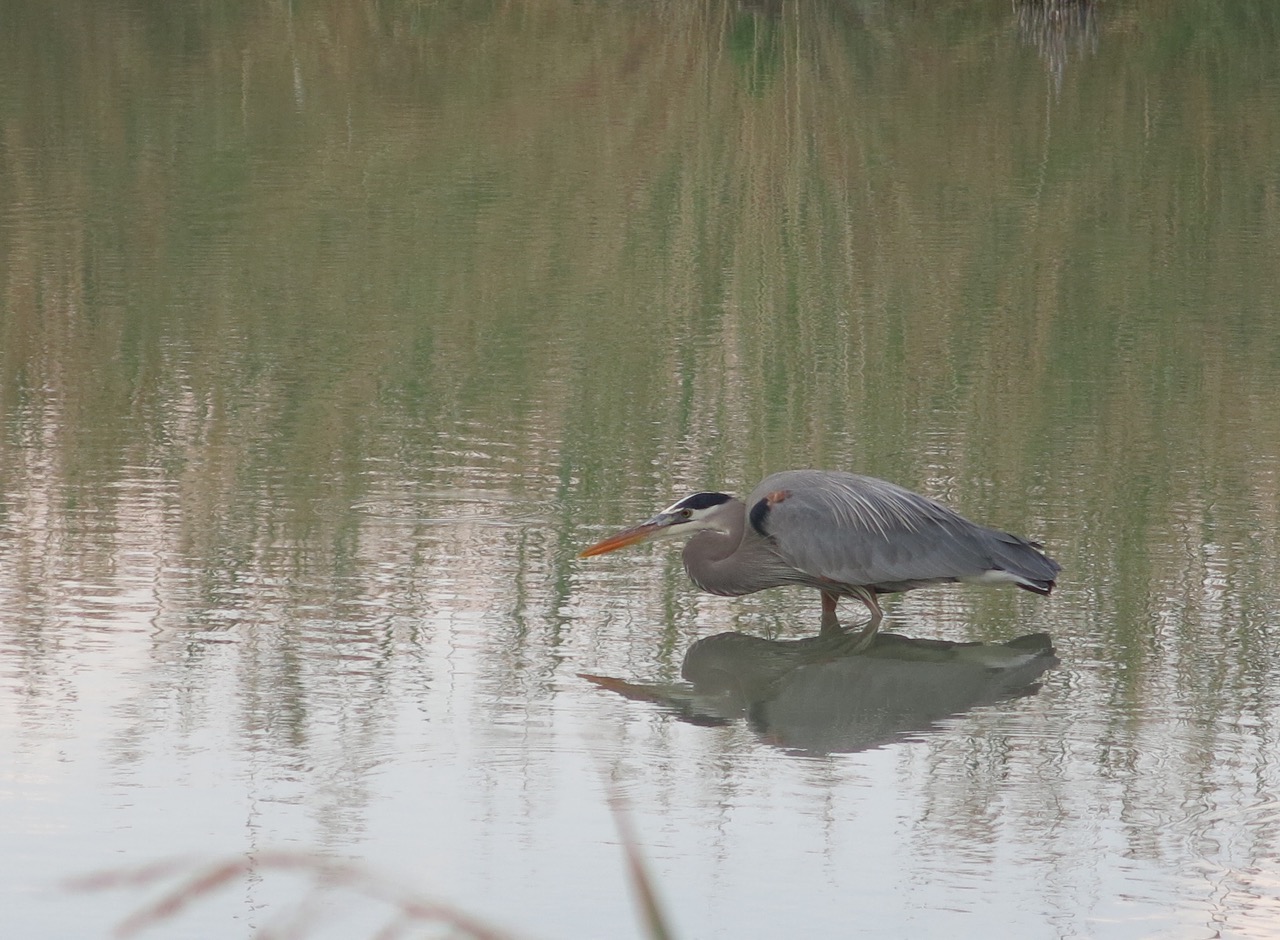
Spring is here. Some might say summer is here. Yesterday the high was 95° and the heat index, 111° in the sun. (However, the low was 35°. Not summer quite yet.) We’ve had real rain (a quarter inch) only once. The next morning I snapped the photo of the great blue heron fishing for his breakfast. The trees in our campground got their annual irrigation. We’ve always wondered about the sign at the entrance that says ‘Low areas subject to flooding during irrigation’. This land used to be farmed, and trees were planted. Turns out those trees like to get their feet wet so in the spring water is pumped out of the river into irrigation ditches. With gates in place, an area is flooded. A couple of days later, the gates are removed and the next area flooded. We spent several days warning tent campers to keep their tents out of the low areas.

On our off days, we hike as much as possible. Recently we hiked The Chimneys trail as a key exchange. One group started hiking at the east end of the 7.4-mile trail, the other at the west end. We met in the middle at lunch, and then each group continued in the same direction they were headed, after exchanging car keys – a step one doesn’t want to forget. This was a relatively level desert hike with petroglyphs, pictographs, ruins from the ranching days and incredible scenery. Yucca, cacti and ocotillo were just beginning to bloom.

Two sets of friends have come to visit. The first couple had never been to Big Bend so we had the pleasure of showing off the park and some of our favorite places. The second couple has been to Big Bend many times surveying caves for the park. With them we (re)discovered a cave and hiked up into the Chisos mountains.


We’ve met the Big Bend National Park pilot and his plane. If I remember correctly, only 3 parks in the lower 48 have a plane and a pilot (Grand Canyon, Voyageurs and Big Bend).

We have been taken to springs and ruins and have sworn never to reveal their locations. We discovered frogs at one spring. Who knew there were frogs in Big Bend? Unfortunately they don’t photograph well hiding amongst the cattails so you’ll just have to believe me. We’ve also driven through Big Bend Ranch State Park, just to the west of Big Bend National Park. The main road is much closer to the river, and the camping, much more primitive. Given more time and fewer people, we’d like to explore their trails. They are also at capacity during spring break. The ranger at the visitor center blanched when Alan suggested we might send campers his way when we were full.
Tomorrow we plan to go to Boquillas for lunch, an outing that requires a passport. Then a couple more days of hosting and packing, and I head home.
 velocityhitstheroad